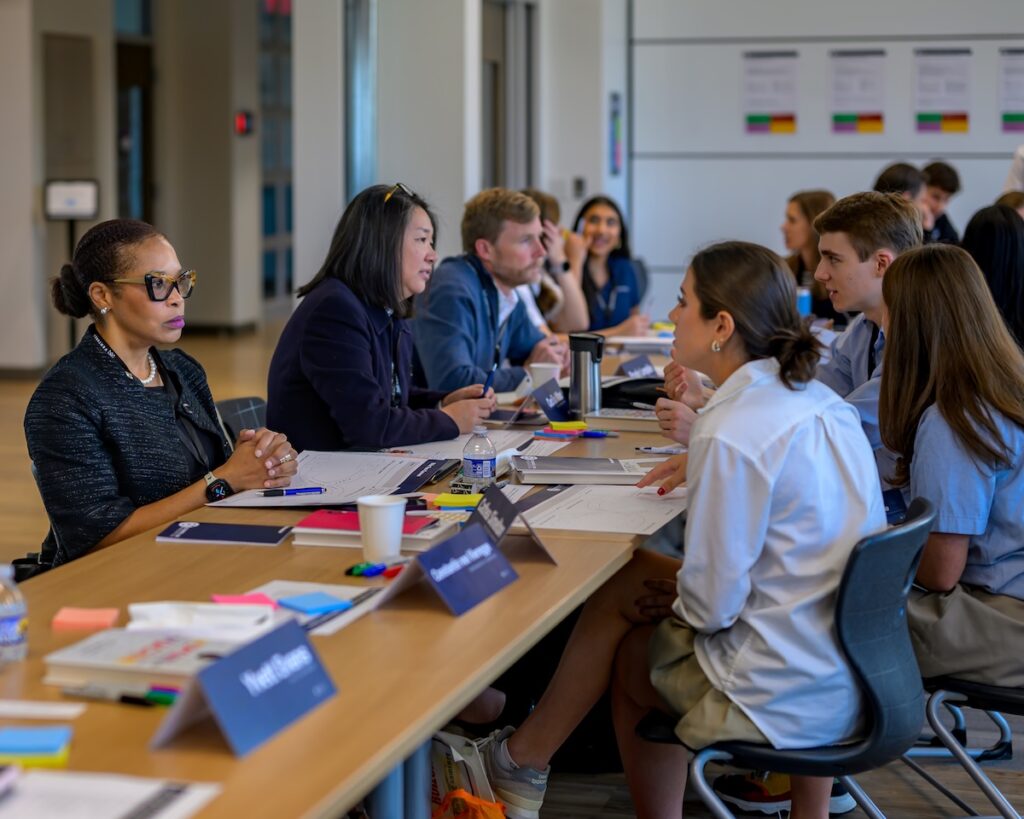
On November 7, 2025, Mount Vernon School welcomed leaders from across industries alongside our own Innovation Diploma students for the annual Council on Innovation. Innovation Diploma students have always partnered with outside organizations, start-ups, and Fortune 500 companies during their junior and senior years, engaging in Design Brief challenges to develop solutions related to real world work. For more than a decade, students from the program have collaborated with business and industry leaders at the annual Council on Innovation, an intensive day of learning and inquiry that’s focused on forging authentic connections between education and various business industries. This year’s half-day, high-energy gathering served as both a think tank and design studio where C-suite executives, entrepreneurs, educators, and students came together to imagine the future of learning and work.
This year’s guiding questions were bold and urgent:
- What is the portrait of the future entry-level worker? What skills will be most important for entry-level workers to be successful over the next 5-10 years?
- What is the portrait of the future workplace? What kind of work environment will foster growth and success among entry-level workers over the next 5-10 years?
- What should the portrait of the future leader look like to ensure our workplaces and the new generation of workers can thrive and grow?
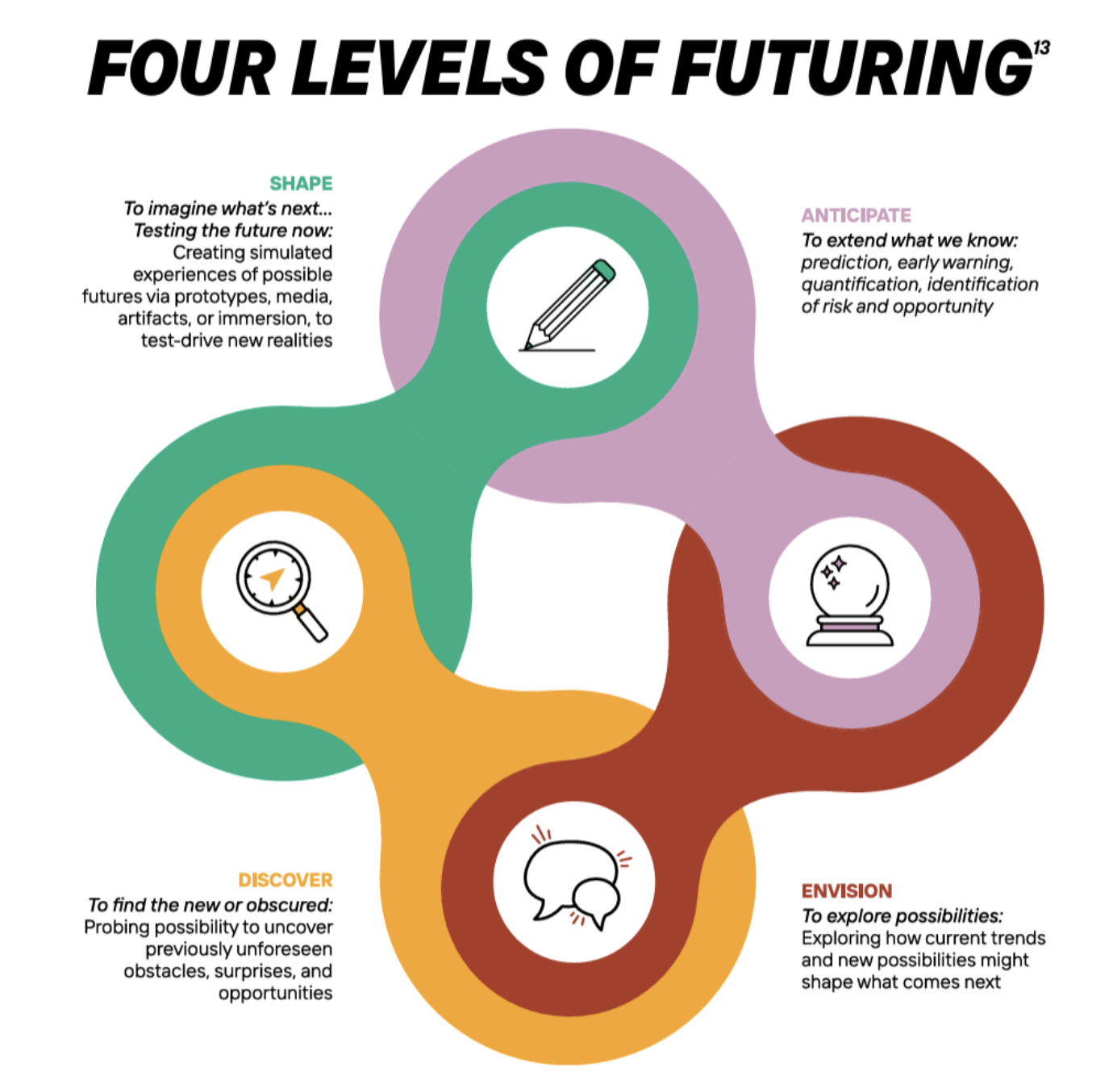 Based on the Mount Vernon Ventures’ R&D report, Imagine Then, Act Now: Futures Literacy for Learning Organizations, we explored the four integral competencies (shown in the clover image) that research and experience tell us are the most important both to live and to thrive in a complex future as well as to shape uncertainty towards preferable, future outcomes.
Succinctly put, in order to live, thrive, and shape possible futures, individuals need a deep sense of self-knowledge, the ability to collaborate effectively with others, the capacity to be creative under constraints, and the literacy to work well with machines.
A Day of Interactivity and Futures Thinking
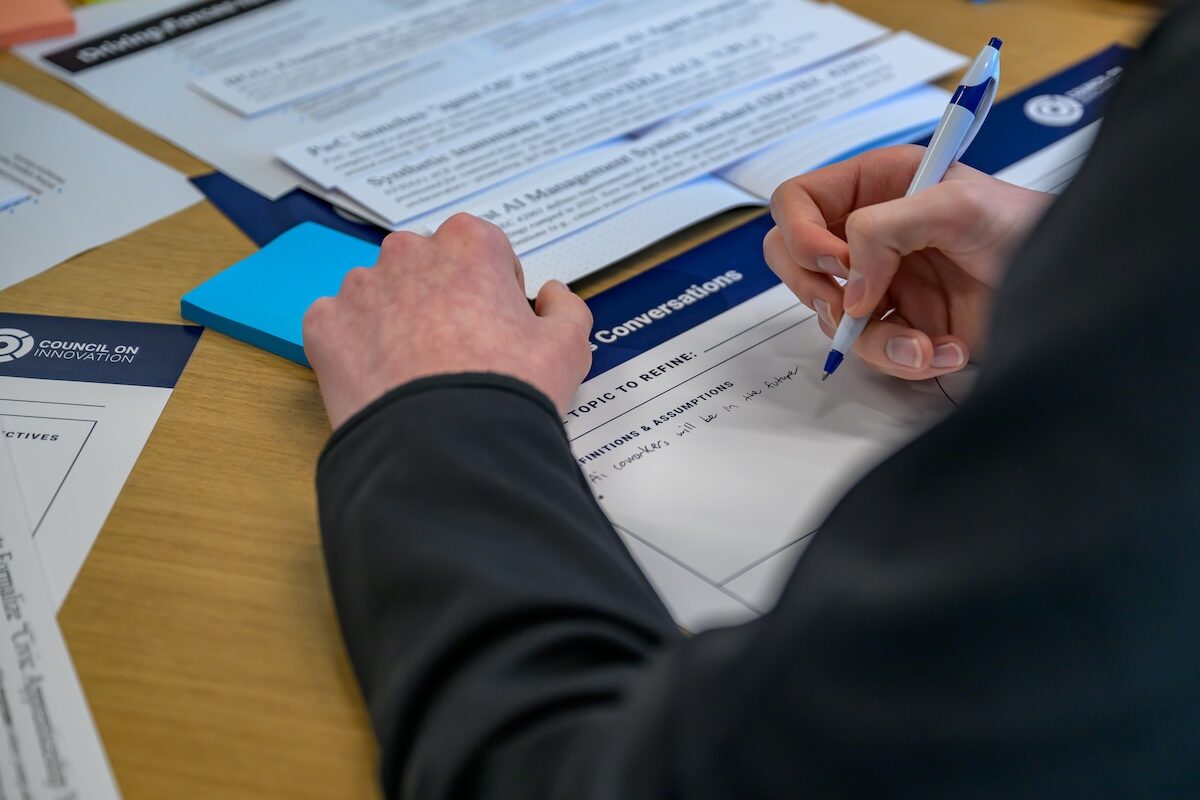
The morning unfolded in a uniquely Mount Vernon way through conversation, collaboration, and creation. Participants were invited to bring artifacts from their own lives and organizations: job descriptions, hiring practices, and skill frameworks which served as real-world fuel for our design sprint.
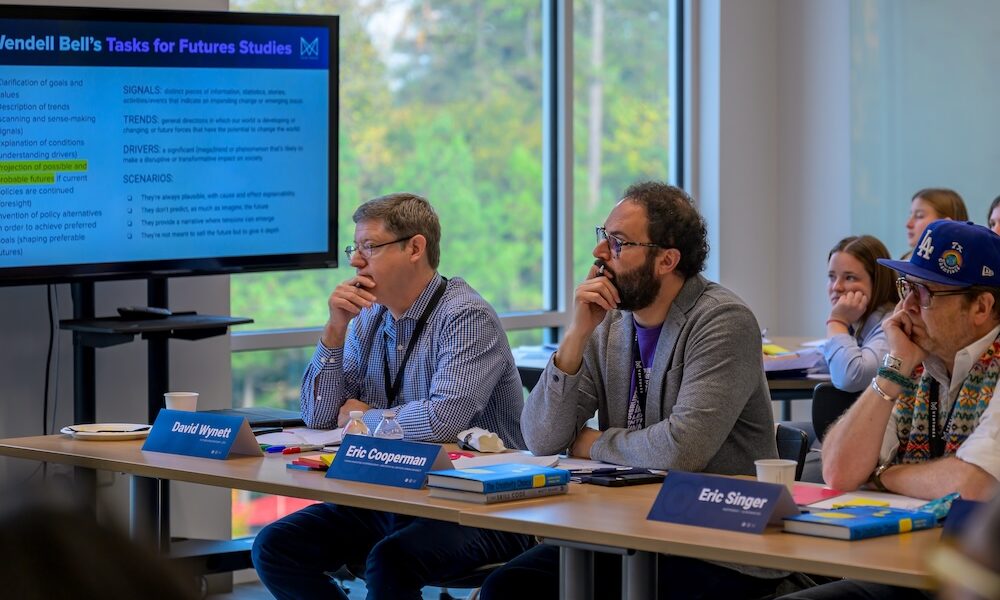
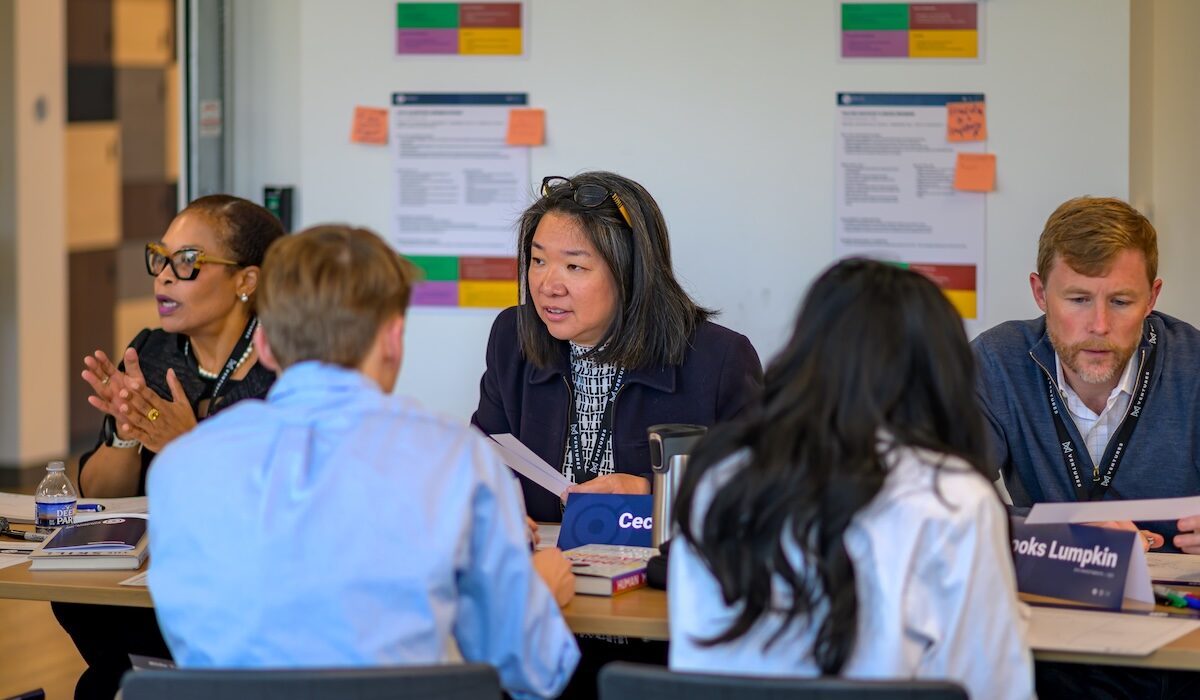
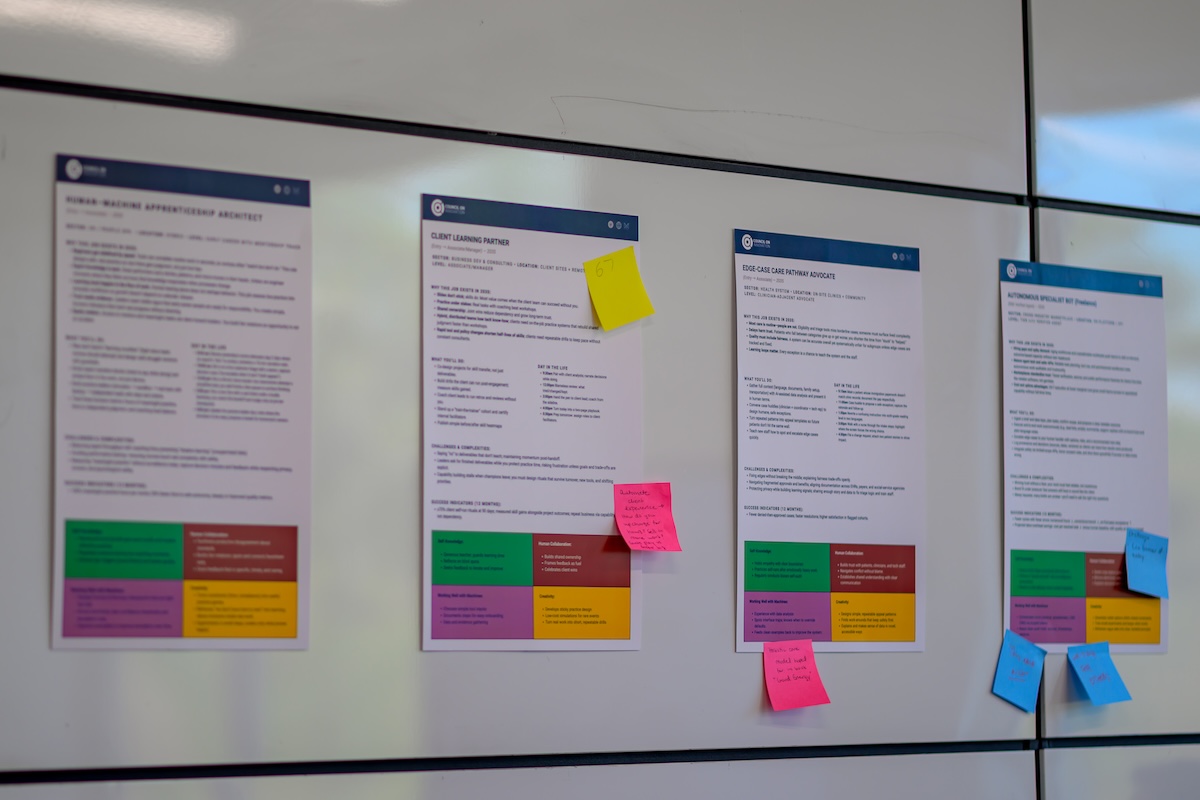
Through Futures Literacy protocols, participants explored signals of change, forecasted emerging trends, and simulated scenarios of future workplaces. Through curated headlines, intimate interviews, and experimentation with generative AI, the signals, drivers, and future forecasts that were excavated provided vivid and provocative visions of both promising and challenging futures, inspiring multi-generational insights and questions. All involved engaged in gallery walks as well, reacting to ready-made, plausible scenarios and “Design Fiction” job ads from the year 2035. Adults and students worked shoulder-to-shoulder—sharing perspectives, challenging assumptions, and sketching bold possibilities. The mix of generations sparked surprising insights: students offered unfiltered visions of what they want school and work to be, while leaders contributed hard-earned wisdom about what industries need most.
Takeaways from Two Perspectives
At Mount Vernon, innovation is not a one-time event but an iterative practice that, through the regular infusion of ideas, fosters the futures literacy we need to inspire intentional, collaborative design. The Council left us with new clarity and inspiration captured best through the eyes of both our adult partners and our student innovators.
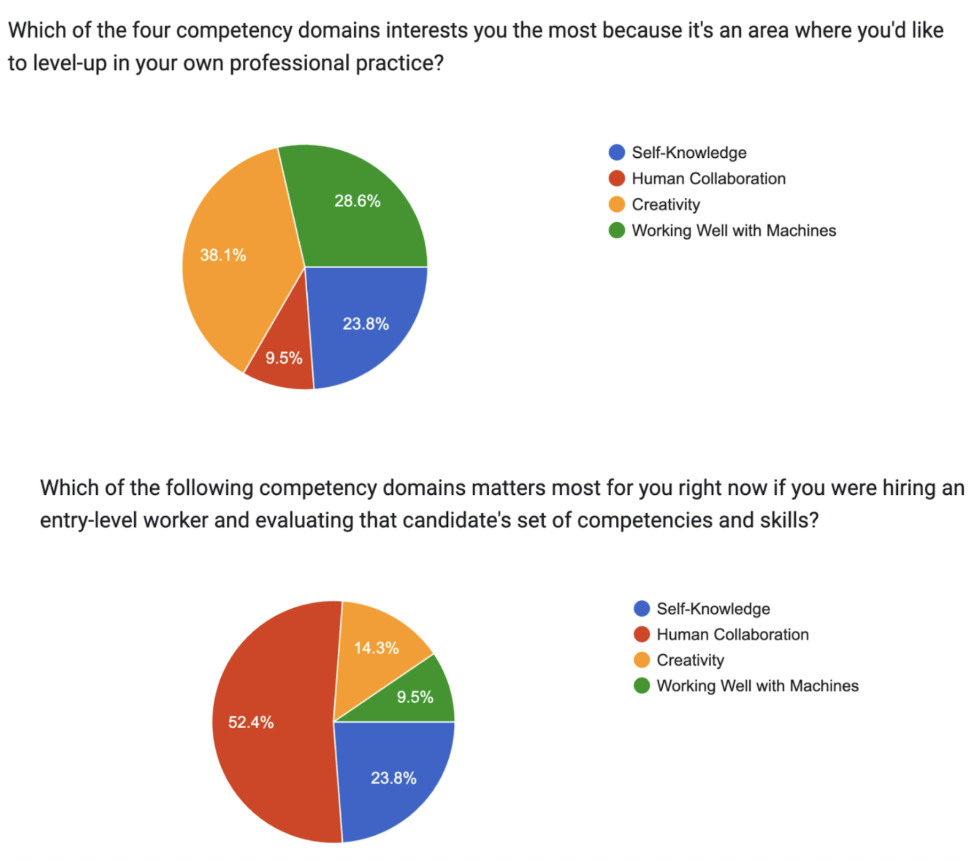
- From the adult perspective: Graduates must be more than “content-ready.” They must be purpose-driven, adaptable, and fluent in collaborating with both humans and machines. Employers seek not just technical expertise, but creativity, empathy, and resilience. These are the very attributes we seek to cultivate at Mount Vernon. In fact, when we surveyed our adult participants, based on the four integral competencies. Results were really interesting, in terms of areas they wanted to grow versus where they saw potential gaps in current, entry-level workers.
- From the student perspective: The workplace should not be a mystery waiting on the other side of graduation. Students want to be at the table now, shaping the conversations about their futures, practicing real-world skills in real-world contexts, and working on problems that matter. One worry that surfaced among young participants was whether there would be jobs at all in a future dominated and hyped by intelligent machines. Fortunately, our collaborative conversations and designs uncovered several hopeful take-aways for this generation’s learners and future leaders.
 Specifically, the Council identified the following attributes and skills for learners entering a future workforce:
- A fusion-skilled collaborator who can think with AI (interrogate, tailor, escalate), exercise judgment under uncertainty, and learn implicitly through safe struggle with real complexity.
- A future-ready mindstate (optimism, openness, curiosity, experimentation, empathy), plus creative self-efficacy and emotional regulation.
- Being comfortable in adaptive processes and motivated by purpose, not just tasks.
With help from our Innovation Diploma students, we also arrived at summary insights about the optimal conditions of a future work environment:
- A learning-dense, apprenticeship-rich environment that protects challenge/complexity/connection and rehumanizes time for distinctly human work.
- Organic human+machine teams with explicit safety/ethics practices and citizen-trainer roles.
- A creativity infrastructure with constraints, time, and social capital opportunities (with both weak + strong ties) designed into projects.
All this left our adult participants with insights as well, specifically about the kind of executive leader needed for future workers and workplace environments to thrive:
- Designers of the missing middle (where humans and machines work together) who model experimentation, invest in informal learning, and anchor responsible AI.
- Reframers who use radical optimism and evolutionary dialogue to expand possibility while holding high expectations for creativity.
The adult participants also left with a clear understanding of what we mean by MV’s mission of being “a school of inquiry, innovation, and impact.” As one business leader and MV parent shared, “The level of care, collaboration, and forward-thinking that was present in the room spoke volumes. It is clear that MV is not only preparing students academically but also nurturing their ability to lead, create, and contribute meaningfully in an ever-changing world. Seeing how deeply the school considers the whole child and the evolving needs of our communities affirmed why I am proud to be part of this MV family.”
A School of Innovation
As a school of innovation, Mount Vernon thrives on these moments of exchange. When ideas from the boardroom meet ideas from the classroom, something powerful happens: futures literacy grows, awareness sharpens, and our community strengthens its ability to intentionally design for what’s ahead.
The Council on Innovation 2025 affirmed what we believe: the future is not something to predict, it is something to design together.
Sources:
- Beane, Matt (2024). The Skill Code: How to Save Human Ability in an Age of Intelligent Machines, Harper Business.
- Colley, Jared (2024). Imagine Then, Act Now: Futures Literacy for Learning Organizations, Spring Transformation R&D Report, Mount Vernon Ventures.
- Daughtery, Paul R. and H. James Wilson (2024). Human + Machine: Reimagining Work in the Age of AI, Harvard Business Review Press.
- Pferdt, Frederik G. (2024). What’s Next Is Now: How to Live Future Ready, Harper Business.
- Pringle, Zorana Ivcevic (2025). The Creativity Choice: The Science of Making Decisions to Turn Ideas Into Action, Public Affairs.